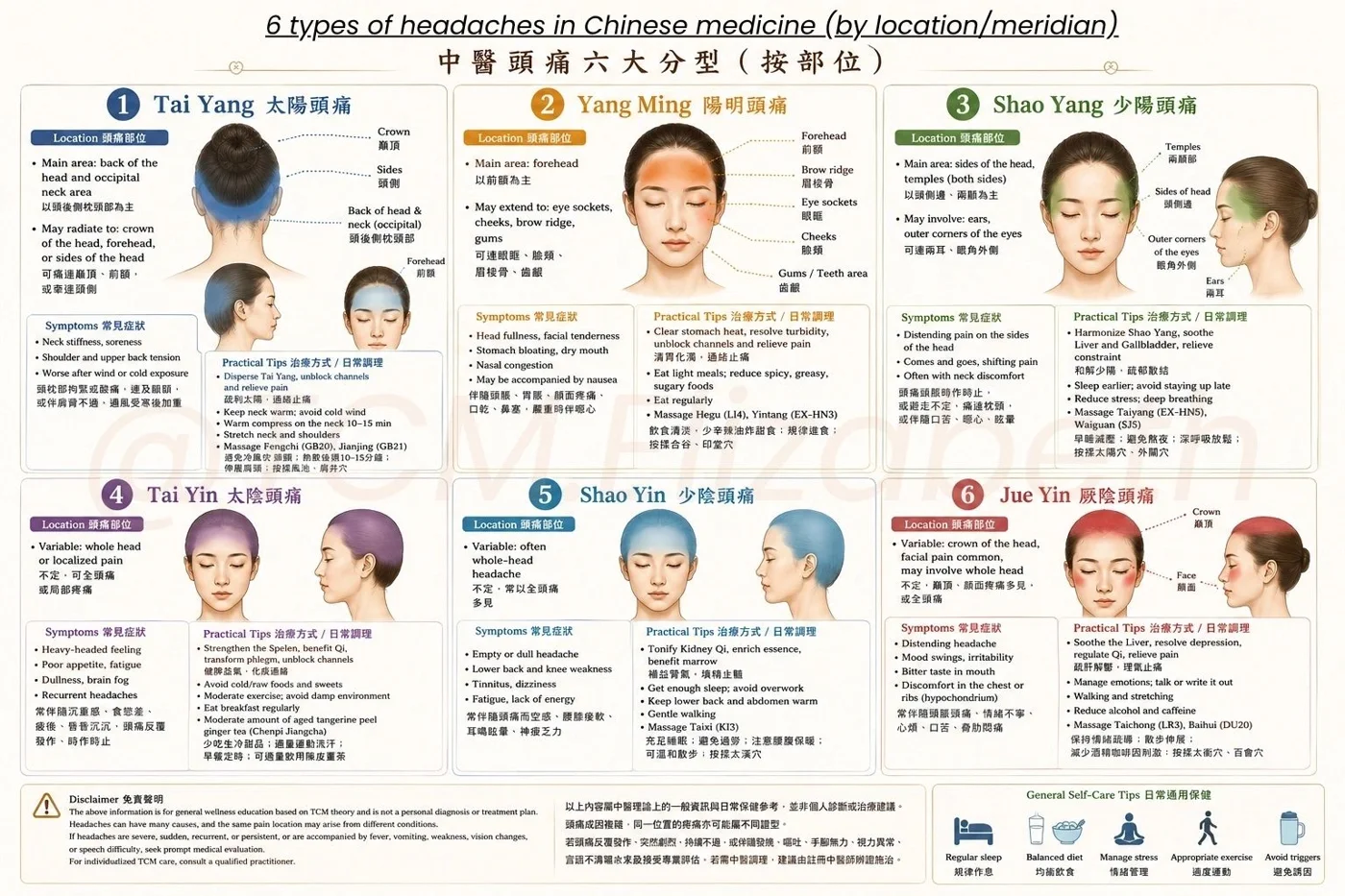
6 types of headaches in Chinese medicine (by location/meridian)
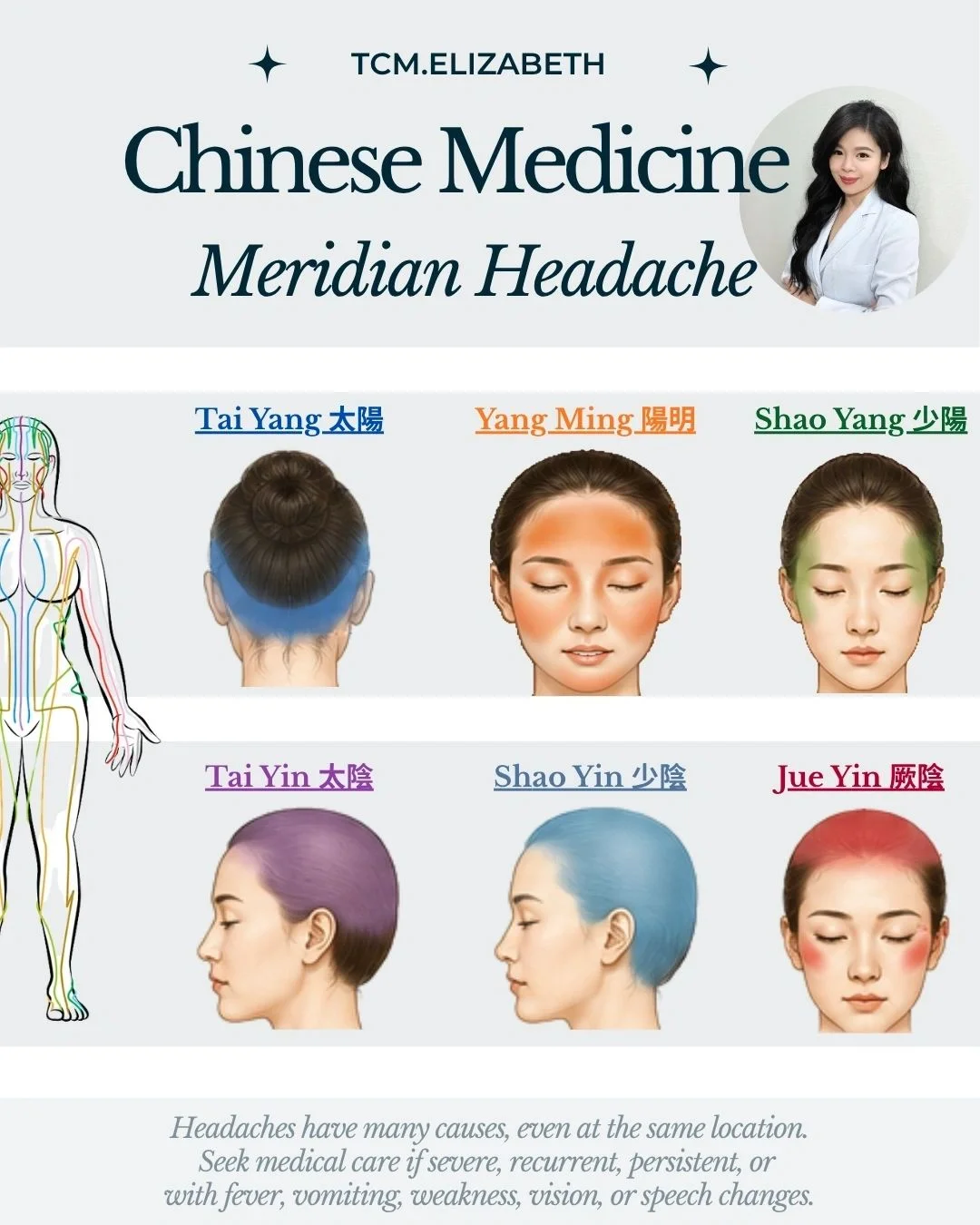
What Can the Location of Your Headache Reveal?
Common Headache Types from a Traditional Chinese Medicine Perspective
In TCM, headaches are not seen as only a head problem. They are often related to meridian pathways, organ function, emotional stress, diet, lifestyle, and body constitution. Different headache locations may reflect different imbalance patterns. Below is a simple guide to common headache types.
1. Tai Yang Headache
■ Location: Back of the head, occipital area, neck; may radiate to the crown, forehead, or sides of the head. ■ Symptoms: Neck stiffness, tightness, soreness, shoulder and upper back tension, worse after wind or cold exposure. ■ Common Causes: Wind-cold invasion, poor posture, neck and shoulder muscle tension. ■ Practical Tips: Keep neck warm; apply a warm compress for 10–15 minutes; stretch neck and shoulders; massage Fengchi (GB20) and Jianjing (GB21).
2. Yang Ming Headache
■ Location: Forehead; may extend to eye sockets, cheeks, brow ridge, gums. ■ Symptoms: Frontal pressure, facial tenderness, bloating, dry mouth, nasal congestion, sometimes nausea. ■ Common Causes: Stomach heat, food stagnation, sinus congestion. ■ Practical Tips: Eat lighter meals; reduce spicy, greasy, sugary foods; eat regularly; massage Hegu (LI4) and Yintang.
3. Shao Yang Headache
■ Location: Sides of the head, temples; may involve ears and outer corners of the eyes. ■ Symptoms: Distending pain, comes and goes, shifting pain, neck discomfort. ■ Common Causes: Stress, emotional tension, sleep deprivation, Liver-Gallbladder imbalance. ■ Practical Tips: Sleep earlier; reduce stress; practice deep breathing; massage Taiyang and Waiguan (SJ5).
4. Tai Yin Headache
■ Location: Variable; whole head or localized pain. ■ Symptoms: Heavy-headed feeling, brain fog, poor appetite, fatigue, recurrent headaches. ■ Common Causes: Spleen deficiency with dampness, phlegm accumulation, excess cold/raw/sugary foods. ■ Practical Tips: Reduce cold/raw sweets; moderate exercise; eat breakfast regularly; moderate intake of aged tangerine peel ginger tea.
5. Shao Yin Headache
■ Location: Variable; often whole-head headache. ■ Symptoms: Empty or dull headache, lower back weakness, tinnitus, dizziness, exhaustion. ■ Common Causes: Kidney deficiency, chronic depletion, overwork. ■ Practical Tips: Prioritize sleep; avoid overwork; keep lower back warm; gentle walking; massage Taixi (KI3).
6. Jue Yin Headache
■ Location: Variable; often crown of head or facial pain, may involve whole head. ■ Symptoms: Distending headache, mood swings, irritability, bitter taste, rib-side discomfort. ■ Common Causes: Liver Qi stagnation, rising Liver Yang, emotional stress. ■ Practical Tips: Manage emotions; walking and stretching; reduce alcohol and caffeine; massage Taichong (LR3) and Baihui (DU20).
Disclaimer
The above information is for general wellness education based on TCM theory and is not a personal diagnosis or treatment plan. Headaches can have many causes, and the same pain location may arise from different conditions. If headaches are severe, sudden, recurrent, persistent, or accompanied by fever, vomiting, weakness, vision changes, or speech difficulty, seek prompt medical evaluation. For individualized TCM care, consult a qualified practitioner.
Content on this site is general health education. It does not replace individual diagnosis or treatment by a doctor or registered Chinese medicine practitioner. In an emergency call 999 or go to A&E.