Common Acupressure Points for Stress Relief & Emotional Balance
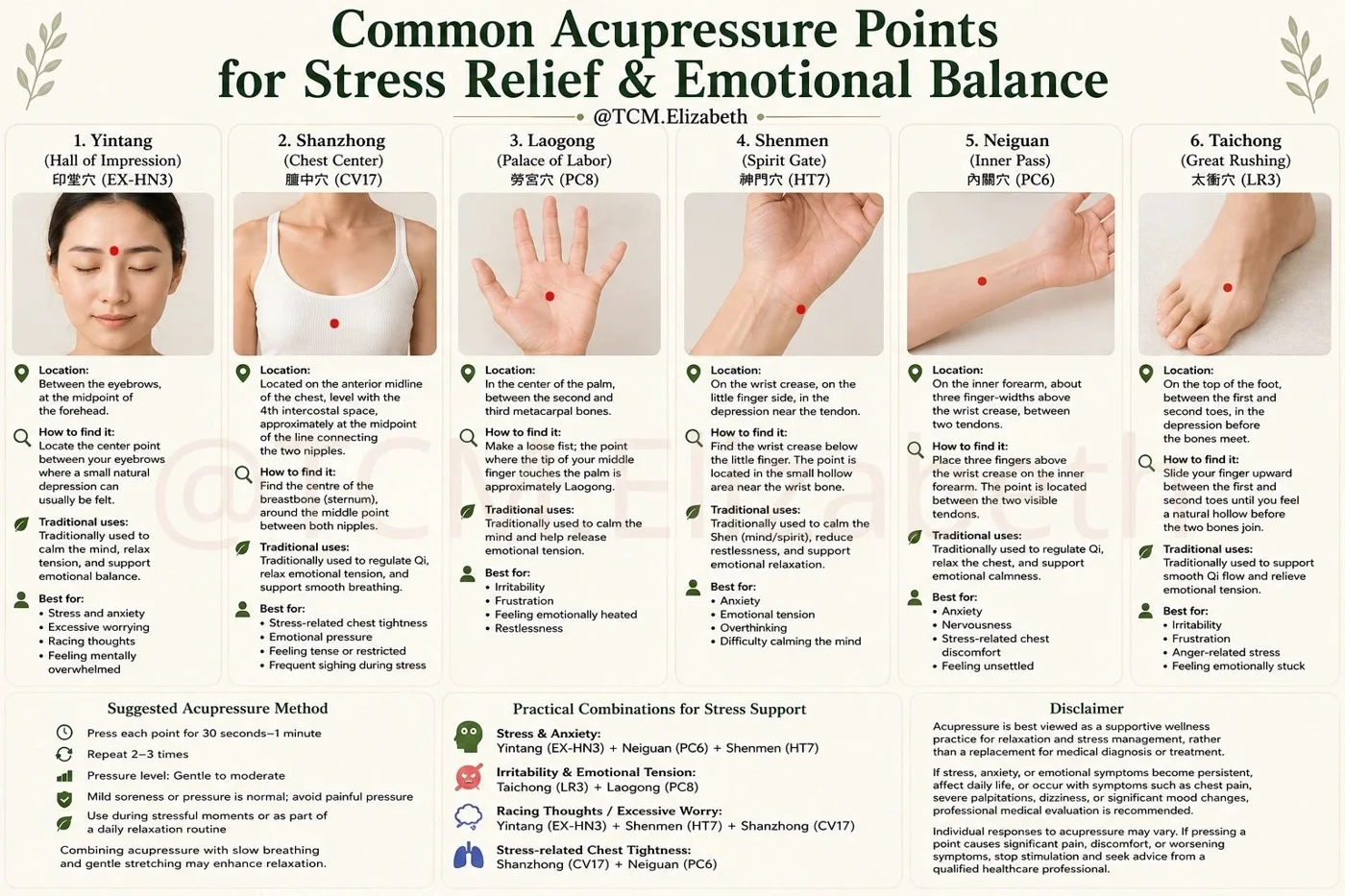
Modern lifestyles, work pressure, emotional stress, and constant mental activity can affect our mood, energy, and overall wellbeing. In Traditional Chinese Medicine (TCM), gentle acupressure is believed to help relax the body, regulate Qi, and calm the mind.
Many people use acupressure as part of their daily stress-management routine to support relaxation, emotional balance, and a sense of calm.
While acupressure is not a replacement for medical treatment, it may be used as a supportive wellness practice.
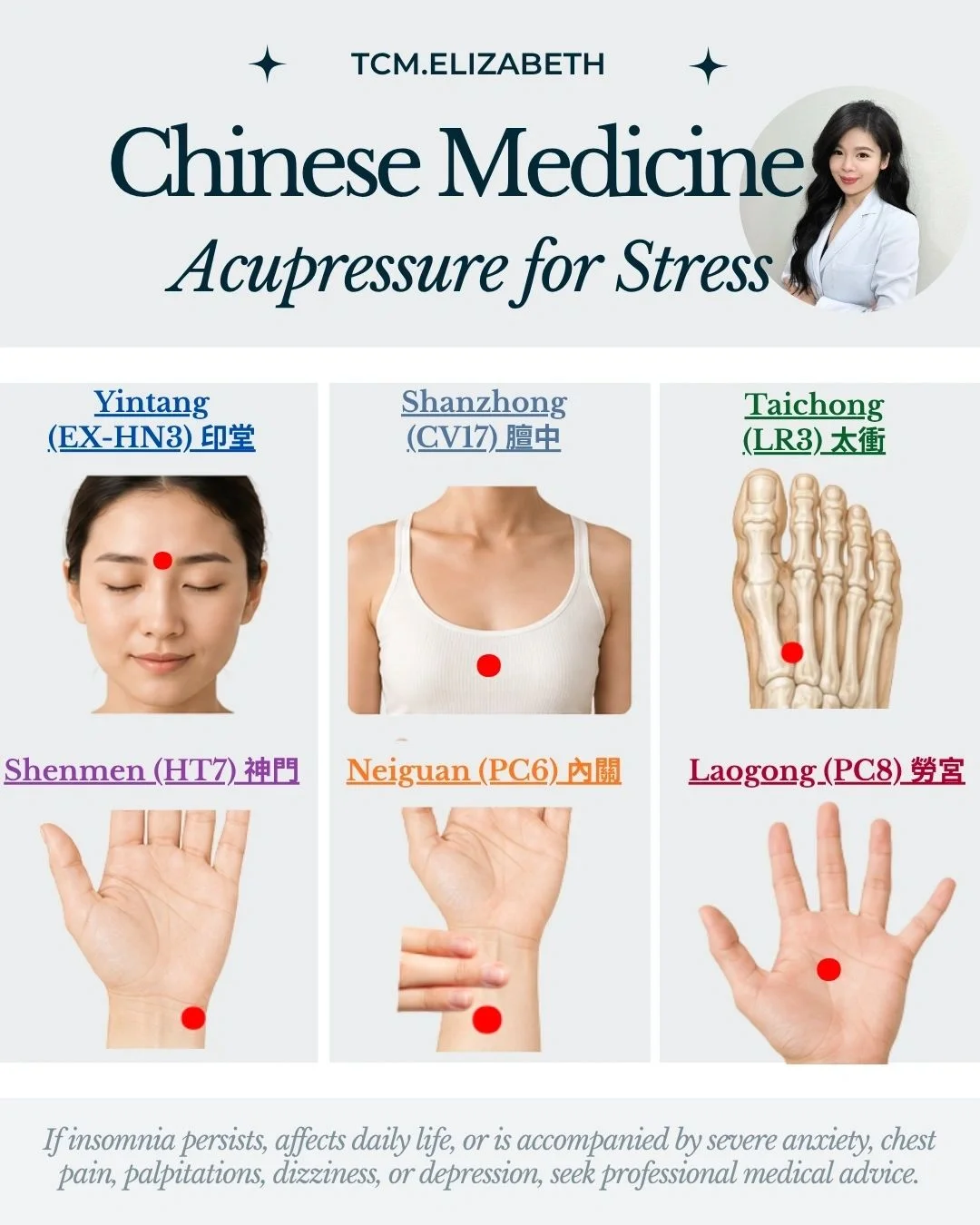
1. Yintang (Hall of Impression) 印堂穴 (EX-HN3)
Location: Between the eyebrows, at the midpoint of the forehead.
How to find it: Locate the center point between your eyebrows where a small natural depression can usually be felt.
Traditional uses: Traditionally used to calm the mind, relax tension, and support emotional balance.
Best for:
Stress and anxiety
Excessive worrying
Racing thoughts
Feeling mentally overwhelmed
2. Shanzhong (Chest Center) 膻中穴 (CV17)
Location: Located on the anterior midline of the chest, level with the 4th intercostal space, approximately at the midpoint of the line connecting the two nipples.
How to find it: Find the centre of the breastbone (sternum), around the middle point between both nipples.
Traditional uses: Traditionally used to regulate Qi, relax emotional tension, and support smooth breathing.
Best for:
Stress-related chest tightness
Emotional pressure
Feeling tense or restricted
Frequent sighing during stress
3. Laogong (Palace of Labor) 勞宮穴 (PC8)
Location: In the center of the palm, between the second and third metacarpal bones.
How to find it: Make a loose fist; the point where the tip of your middle finger touches the palm is approximately Laogong.
Traditional uses: Traditionally used to calm the mind and help release emotional tension.
Best for:
Irritability
Frustration
Feeling emotionally heated
Restlessness
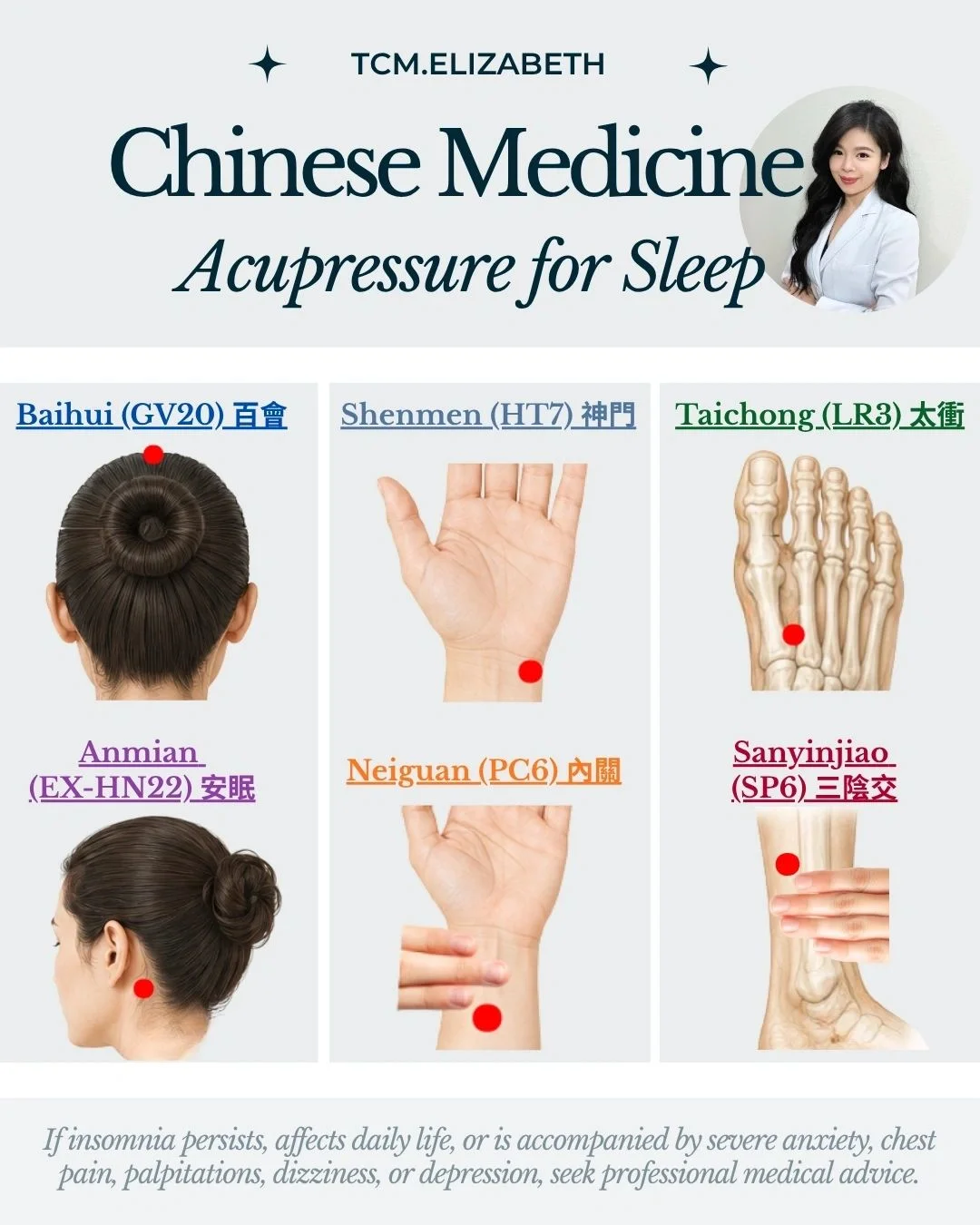
4. Shenmen (Spirit Gate) 神門穴 (HT7)
Location: On the wrist crease, on the little finger side, in the depression near the tendon.
How to find it: Find the wrist crease below the little finger. The point is located in the small hollow area near the wrist bone.
Traditional uses: Traditionally used to calm the Shen (mind/spirit), reduce restlessness, and support emotional relaxation.
Best for:
Anxiety
Emotional tension
Overthinking
Difficulty calming the mind
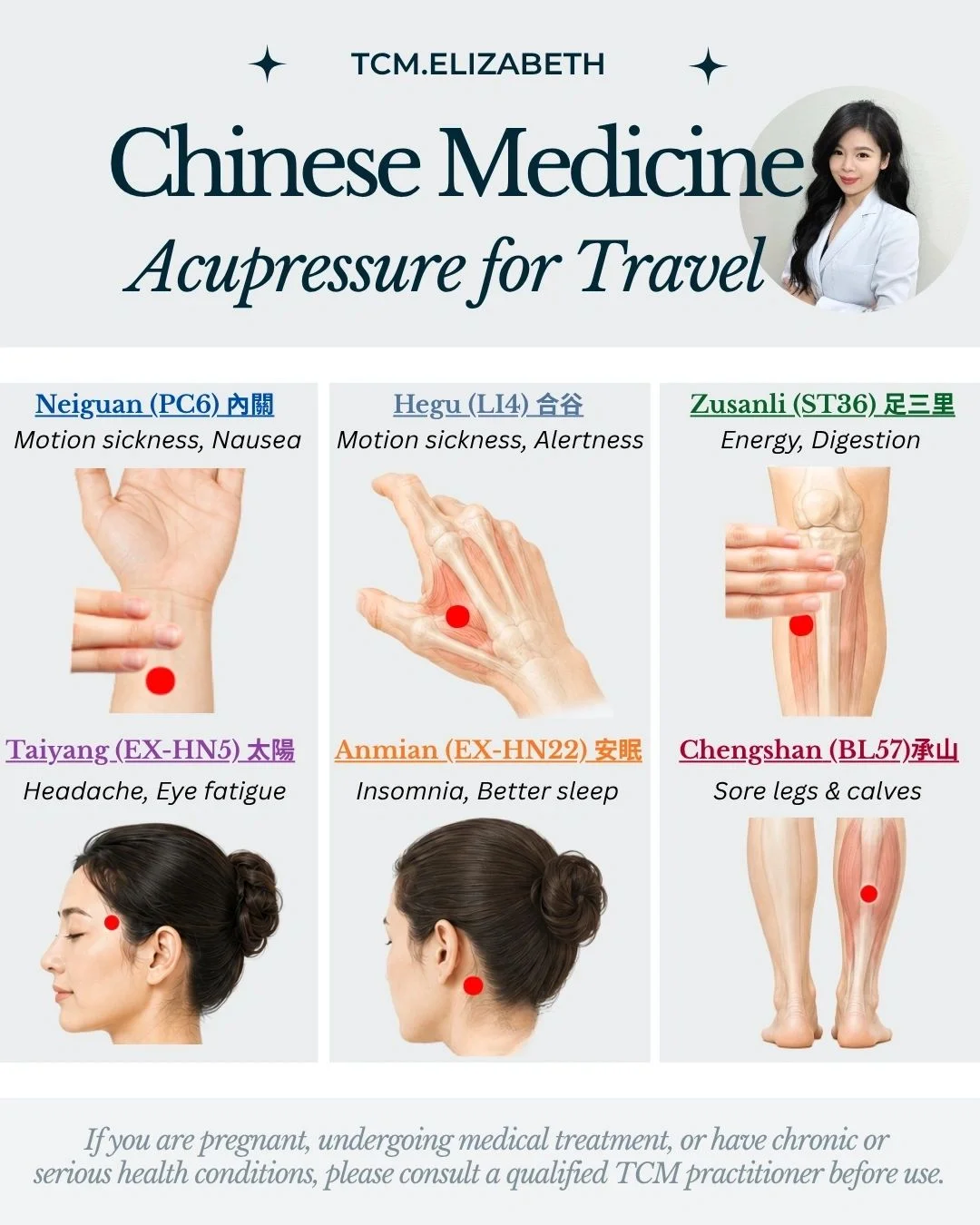
5. Neiguan (Inner Pass) 內關穴 (PC6)
Location: On the inner forearm, about three finger-widths above the wrist crease, between two tendons.
How to find it: Place three fingers above the wrist crease on the inner forearm. The point is located between the two visible tendons.
Traditional uses: Traditionally used to regulate Qi, relax the chest, and support emotional calmness.
Best for:
Anxiety
Nervousness
Stress-related chest discomfort
Feeling unsettled
6. Taichong (Great Rushing) 太衝穴 (LR3)
Location: On the top of the foot, between the first and second toes, in the depression before the bones meet.
How to find it: Slide your finger upward between the first and second toes until you feel a natural hollow before the two bones join.
Traditional uses: Traditionally used to support smooth Qi flow and relieve emotional tension.
Best for:
Irritability
Frustration
Anger-related stress
Feeling emotionally stuck
Suggested Acupressure Method
Press each point for 30 seconds–1 minute
Repeat 2–3 times
Pressure level: Gentle to moderate
Mild soreness or pressure is normal; avoid painful pressure
Use during stressful moments or as part of a daily relaxation routine
Combining acupressure with slow breathing and gentle stretching may enhance relaxation.
Practical Combinations for Stress Support
Stress & Anxiety: Yintang (EX-HN3) + Neiguan (PC6) + Shenmen (HT7)
Irritability & Emotional Tension: Taichong (LR3) + Laogong (PC8)
Racing Thoughts / Excessive Worry: Yintang (EX-HN3) + Shenmen (HT7) + Shanzhong (CV17)
Stress-related Chest Tightness: Shanzhong (CV17) + Neiguan (PC6)
Disclaimer
Acupressure is best viewed as a supportive wellness practice for relaxation and stress management, rather than a replacement for medical diagnosis or treatment.
If stress, anxiety, or emotional symptoms become persistent, affect daily life, or occur with symptoms such as chest pain, severe palpitations, dizziness, or significant mood changes, professional medical evaluation is recommended.
Individual responses to acupressure may vary. If pressing a point causes significant pain, discomfort, or worsening symptoms, stop stimulation and seek advice from a qualified healthcare professional.
Content on this site is general health education. It does not replace individual diagnosis or treatment by a doctor or registered Chinese medicine practitioner. In an emergency call 999 or go to A&E.