Facial Gua Sha: Benefits, Acupuncture Points & How to Do It
Facial Gua Sha: Benefits, Acupuncture Points & How to Do It Properly
Facial Gua Sha has become increasingly popular in the beauty and wellness world, often praised for helping reduce puffiness, relieve facial tension, and support a healthy glow. While many people know it as a skincare trend, Facial Gua Sha actually has roots in Traditional Chinese Medicine (TCM), where it is used to encourage circulation, promote relaxation, and support the natural balance of the body.
Unlike body Gua Sha, which is often firmer and may leave temporary redness, Facial Gua Sha uses a much gentler technique designed specifically for the delicate skin and muscles of the face. When done correctly and consistently, it can become a simple and effective self-care ritual.
What Is Facial Gua Sha?
Facial Gua Sha involves using a smooth-edged tool, often made from stone or metal, to glide across the face in repeated strokes. The movement is usually upward and outward, helping release muscular tension and encourage lymphatic drainage.
Many people use Facial Gua Sha to support:
Facial puffiness reduction
Jaw tension relief
Better circulation
Relaxation
A brighter-looking complexion
Support for natural facial tone
It is important to remember that Facial Gua Sha should feel soothing and gentle — not painful or aggressive.
The Chinese Medicine Theory Behind Facial Gua Sha
In Traditional Chinese Medicine, health depends on the smooth flow of Qi and Blood throughout the body. Qi can be understood as vital energy that circulates through pathways called meridians.
When Qi and Blood flow smoothly, tissues are nourished and the body functions harmoniously. When circulation becomes sluggish due to stress, poor sleep, tension, or lifestyle habits, this may show on the face as:
Puffiness
Dull complexion
Tight jaw muscles
Tension headaches
Dark under-eye appearance
Facial tightness
Facial Gua Sha helps stimulate circulation, move stagnation, and relax the muscles of the face and neck. In Chinese medicine, the face is closely connected to the internal organs, so facial appearance often reflects internal balance.
How to Do Facial Gua Sha
Before You Start
Cleanse your face
Apply facial oil or serum to allow smooth gliding
Hold the tool at a low angle against the skin
Use light to moderate pressure only
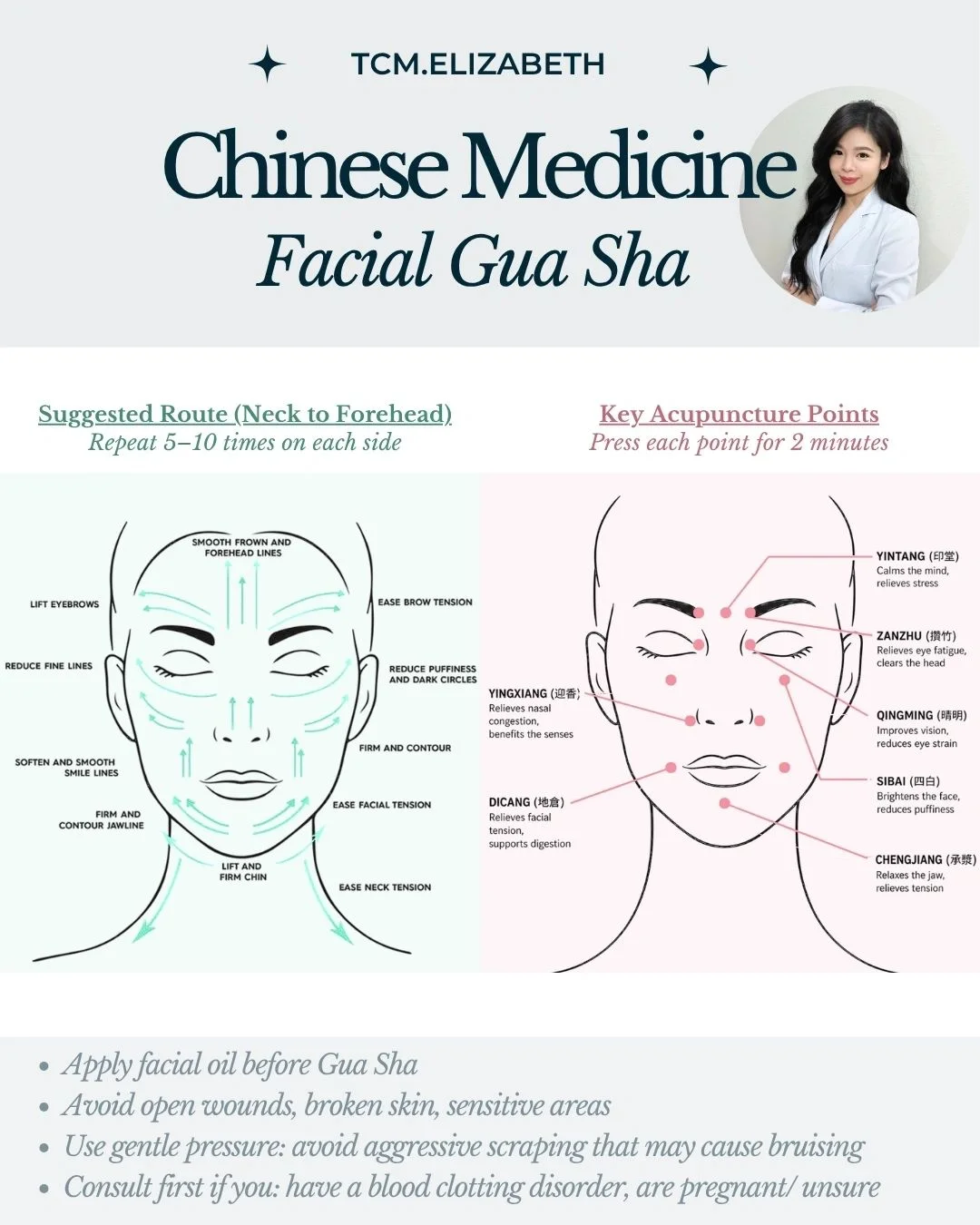
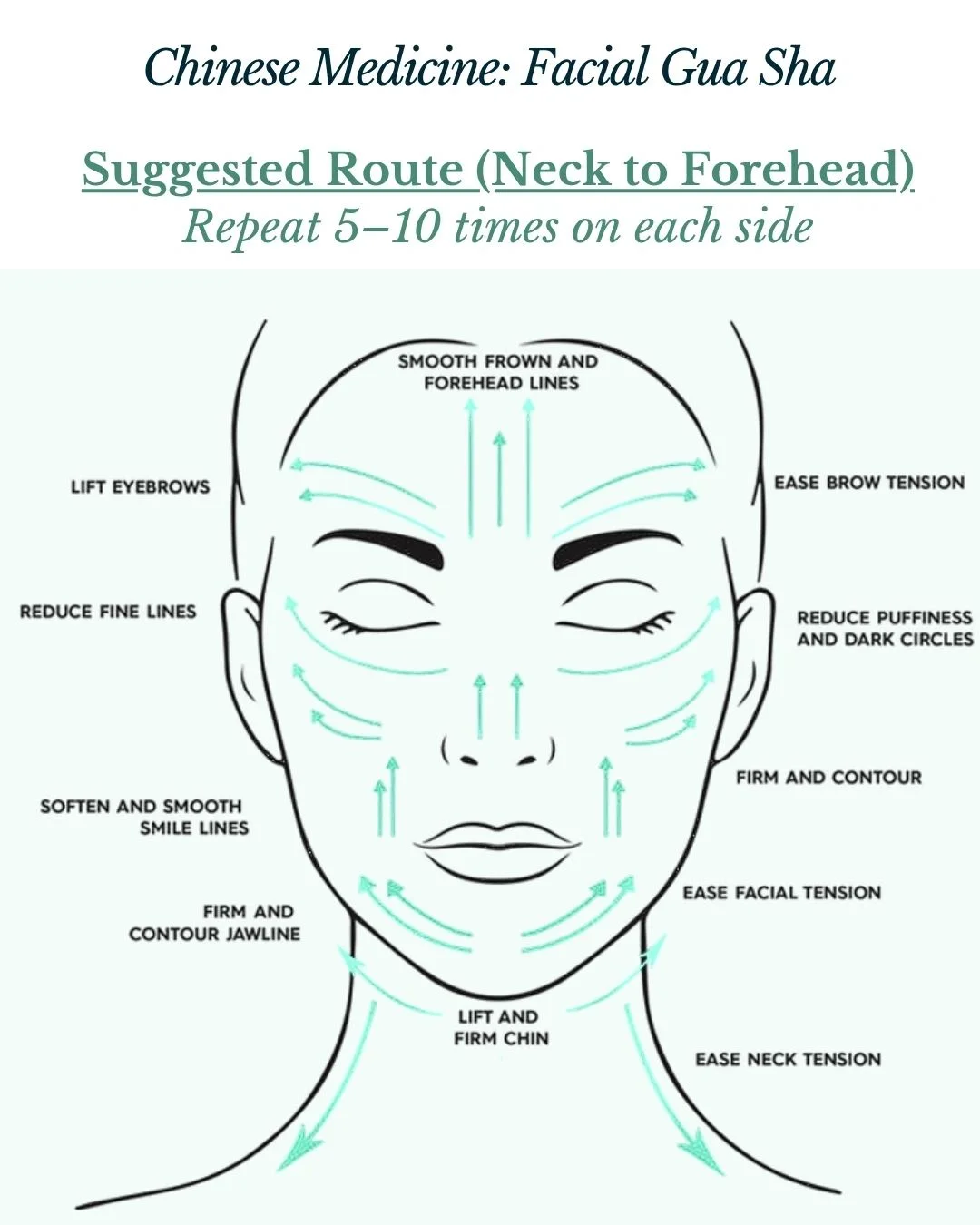
Suggested Routes (Neck to Forehead)
* Gentle consistency is better than aggressive scraping. Strong pressure can irritate the skin and cause bruising.
1. Neck
Glide downward along the sides of the neck to encourage drainage and release tension.
2. Jawline
Start from the chin and glide toward the ear.
3. Cheeks
Move from beside the mouth outward toward the ears.
4. Under Eye Area
Use extremely gentle pressure from inner to outer eye area.
5. Brows and Temples
Glide from the inner brow outward toward the temples.
6. Forehead
Stroke upward from brows toward hairline, then outward.
Repeat each route 5–10 times on each side.
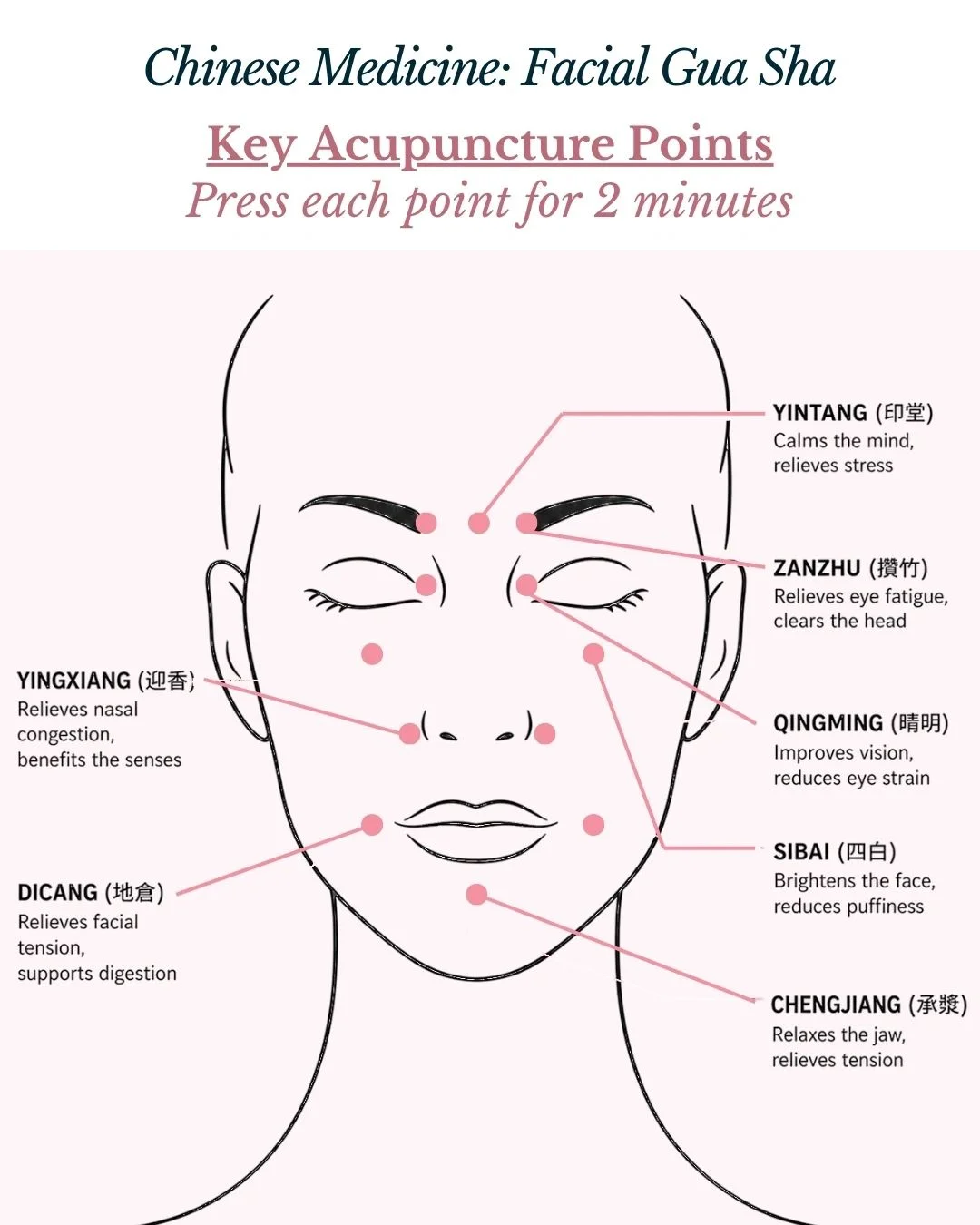
Key Acupuncture Points for Facial Gua Sha
Yin Tang (EX-HN3)
Location: Midpoint between the eyebrows
Beauty Functions: Reduces frown lines, promotes glowing skin
Traditional Functions: Calms the mind, relieves headache
Zan Zhu (BL2)
Location: At the inner end of the eyebrow
Beauty Functions: Softens forehead lines, lifts brow area
Traditional Functions: Relieves headache, benefits the eyes
Qing Ming (BL1)
Location: Inner corner of the eye
Beauty Functions: Reduces puffiness, improves dark circles
Traditional Functions: Benefits vision, clears redness of the eyes
Ying Xiang (LI20)
Location: Beside the nostrils
Beauty Functions: Softens smile lines, improves skin tone
Traditional Functions: Opens nasal passages, relieves sinus congestion
Si Bai (ST2)
Location: Directly below the pupil
Beauty Functions: Reduces eye bags, tones cheeks
Traditional Functions: Benefits the eyes, relieves facial pain
Di Cang (ST4)
Location: Lateral to the corner of the mouth
Beauty Functions: Lifts mouth corners, reduces marionette lines
Traditional Functions: Relieves facial paralysis, benefits the mouth
Cheng Jiang (CV24)
Location: Center of the chin-labial groove
Beauty Functions: Defines jawline, improves lower face circulation
Traditional Functions: Benefits gums, relieves facial swelling
Who May Benefit from Facial Gua Sha?
Facial Gua Sha may be helpful for people who experience:
Morning puffiness
Jaw tension
Tight facial muscles
Stress-related tension headaches
Screen-related eye strain
Dull complexion
Desire for a natural wellness routine
It can also be a calming ritual that encourages mindfulness and stress relief.
Many people enjoy 4–6 times weekly or short daily sessions.
Results often come from regular gentle practice rather than intensity.
Who Should Avoid or Use Caution?
Avoid Facial Gua Sha over:
Open wounds
Broken skin
Active acne inflammation
Rashes
Sunburned skin
Irritated sensitive areas
Use caution or seek professional advice if you have:
Blood clotting disorders
Very reactive skin conditions
Recent facial surgery
Recent cosmetic injectables
Pregnancy
Ongoing unexplained skin concerns
Professional Treatment: Facial Acupuncture in Clinic
While home Facial Gua Sha is excellent for maintenance and relaxation, clinical treatment can offer a more personalised and targeted approach.
Facial acupuncture uses very fine sterile needles placed on selected facial and body acupuncture points according to your individual constitution and concerns.
This may be used to support:
Facial circulation
Jaw tension
Stress management
Sleep quality
Digestive balance
Overall vitality
In Chinese medicine, treatment often focuses not only on the face itself, but also on underlying imbalances that may contribute to puffiness, tension, or dullness.
Final Thoughts
Facial Gua Sha is more than a beauty trend — it is a gentle self-care practice rooted in Traditional Chinese Medicine. By combining mindful movement, improved circulation, and tension release, it can support both appearance and wellbeing.
Start gently, stay consistent, and listen to your skin. Even a few minutes several times a week can become a valuable part of your wellness routine.
Disclaimer
This article is for educational purposes only and is not medical advice. Results vary between individuals. Stop if pain, bruising, or irritation occurs. If you have medical conditions or are unsure whether Facial Gua Sha is suitable for you, seek personalised advice from a qualified healthcare professional or TCM practitioner.
Content on this site is general health education. It does not replace individual diagnosis or treatment by a doctor or registered Chinese medicine practitioner. In an emergency call 999 or go to A&E.