Tongue Areas and Organ Mapping: Chinese Medicine Perspective
1. Introduction to Tongue Diagnosis
In Traditional Chinese Medicine (TCM), the tongue is viewed as a reflection of internal organ function and overall physiological balance.
By observing the tongue, practitioners assess the state of:
Qi and Blood.
Yin and Yang.
Internal organ systems.
1.1 Tongue Areas and Organ Mapping
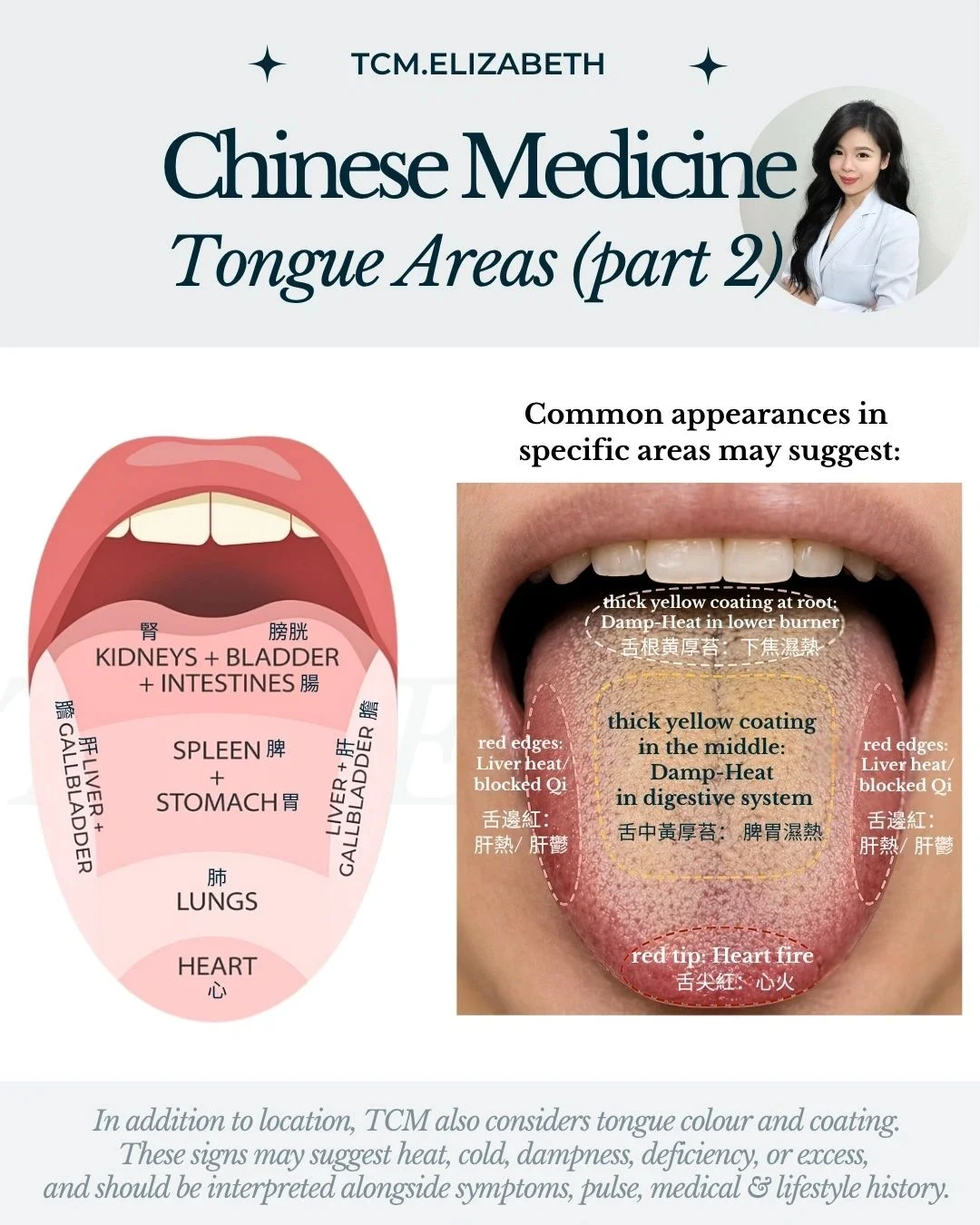
Different regions of the tongue correspond to different parts of the body:
Tip → Upper Burner, especially the Heart and Lung.
Middle → Middle Burner, especially the Spleen and Stomach.
Sides → Liver and Gallbladder.
Root → Lower Burner, including the Kidneys, bladder, intestines, and reproductive system.
This regional mapping provides clinical guidance, but it is not used in isolation.
1.2 Tongue Colour and Coating
In addition to location, TCM also evaluates:
Tongue colour, such as red, pale, or purple.
Tongue coating, such as thick, thin, yellow, white, greasy, or dry.
These features may suggest patterns such as heat, cold, dampness, deficiency, or excess.
Check this for more: https://elizabethyau.com/blog/f/chinese-medicine-tongue-diagonsis
2. Tip of the Tongue: Upper Burner
The tip of the tongue reflects the Upper Burner, particularly the Heart, which governs the Shen and is closely related to the mind and emotional state.
2.1 Red Tip of the Tongue
A red tongue tip is commonly associated with Heart heat or Heart fire.
What it may suggest:
Irritability or restlessness.
Insomnia or vivid dreams.
Palpitations.
Mouth ulcers or tongue sores.
Dry mouth or thirst.
Flushed face.
Possible contributing factors:
Emotional stress or anxiety.
Excessive consumption of spicy foods, alcohol, or caffeine.
Sleep deprivation.
Internal heat accumulation.
2.2 Other Possible Interpretations
A red tip does not always point to Heart fire alone. It may also be seen with:
Yin deficiency with empty heat.
An early stage of an external heat condition, such as a viral illness.
Emotional or psychological stress affecting the Shen.
3. Middle of the Tongue: Middle Burner
The middle of the tongue reflects the digestive system, particularly the Spleen and Stomach.
3.1 Thick Yellow Coating in the Middle
A thick yellow coating in the center of the tongue is commonly associated with Damp-Heat affecting the Spleen and Stomach.
What it may suggest:
Poor appetite.
Bloating or abdominal fullness.
Nausea or acid reflux.
Sticky or foul-smelling stools.
Bad breath.
Heaviness in the body.
Oily skin or acne.
Possible contributing factors:
Overeating, especially greasy or sweet foods.
Alcohol consumption.
Irregular eating habits.
Weak Spleen function leading to damp accumulation.
3.2 Other Possible Interpretations
This presentation may also be seen with:
Food stagnation.
External Damp-Heat, especially in hot and humid environments.
Gastrointestinal infections.
Temporary dietary effects.
3.3 Other Common Appearances in the Middle Region
Thick white coating → Cold-Damp accumulation in the Spleen and Stomach.
Thin white coating → Normal or mild external condition.
Greasy coating → Dampness or Phlegm retention.
Peeling or patchy coating → Stomach Yin deficiency.
Dry, cracked center → Stomach Yin deficiency or fluid depletion.
Swollen tongue with teeth marks → Spleen Qi deficiency with Damp.
Sticky coating that is difficult to remove → Damp turbidity or food stagnation.
4. Sides of the Tongue: Liver and Gallbladder
The sides of the tongue reflect the Liver system, which is closely related to emotional regulation and the smooth flow of Qi.
4.1 Red Edges of the Tongue
Redness along the edges is commonly associated with Liver heat or Liver Qi stagnation transforming into heat.
What it may suggest:
Irritability or mood swings.
Emotional stress or frustration.
Headaches or dizziness.
Bitter taste in the mouth.
Chest or rib-side tightness.
Menstrual irregularities.
Possible contributing factors:
Chronic emotional stress.
Suppressed emotions.
Poor sleep.
Diet contributing to internal heat.
4.2 Other Possible Interpretations
Red edges may also reflect:
Liver Yin deficiency.
General internal heat.
Gallbladder heat.
5. Root of the Tongue: Lower Burner
The root of the tongue reflects the Lower Burner, including the Kidneys and the lower body.
5.1 Thick Yellow Coating at the Root
A thick yellow coating at the back of the tongue is commonly associated with Damp-Heat in the Lower Burner.
What it may suggest:
Dark or burning urination.
Urinary discomfort.
Sticky stools or diarrhea.
Lower abdominal heaviness.
Lower back discomfort.
Gynecological symptoms such as discharge or recurrent infections.
Possible contributing factors:
A diet high in greasy, spicy, foods.
Sedentary lifestyle.
Chronic damp accumulation.
5.2 Other Possible Interpretations
This may also be associated with:
Kidney Yin deficiency with empty heat.
Chronic inflammation.
Long-term digestive imbalance.
5.3 Other Common Appearances in the Root Region
Thick white coating → Cold-Damp in the Lower Burner.
Very wet or overly moist appearance → Kidney Yang deficiency.
Dry root with little or no coating → Kidney Yin deficiency.
Dark or purplish root → Blood stasis in the lower body.
Swollen root → Fluid retention or Damp accumulation.
Uneven or peeled coating → Chronic deficiency or long-term imbalance.
6. Final Note
Tongue diagnosis is a valuable but holistic diagnostic method in TCM.
It should always be interpreted alongside:
Full symptom analysis.
Pulse diagnosis.
Medical and lifestyle history.
Tongue signs are best understood as pattern clues rather than standalone diagnoses.
This article is intended for educational purposes only and should not be used for self-diagnosis. For an accurate assessment and personalised treatment, please consult a qualified TCM practitioner.
Content on this site is general health education. It does not replace individual diagnosis or treatment by a doctor or registered Chinese medicine practitioner. In an emergency call 999 or go to A&E.